Top Things to Do in Brazzaville
3 must-see attractions and experiences
Brazzaville stares across fewer than five kilometers of brown, swirling water at Kinshasa. These two capitals are the closest pair on Earth. The city carries a distinctly Francophone ease. Grilled fish drifts off the waterfront at dusk. Soukous guitar bleeds from open bars in Poto-Poto. The equatorial air stays warm even after the sun drops below the treetops. Where the Congo River throws silver light across the corniche, Brazzaville looks like a city that has decided to take its time. First-time visitors are often surprised by the unhurried tempo. No relentless commercial pressure. No crush of tourist infrastructure. The Plateau district and the riverfront are navigable during daylight. The city rewards travelers who lean into its pace. Brazzaville's residential neighborhoods, Bacongo, Moungali, Mfilou, each carry their own texture. Crumbling French colonial facades sit beside new evangelical churches. Catholic compounds stand a century old. The food is the city's most undersung pleasure. Pondu, cassava leaves cooked with palm oil and dried fish, sits on every family table. Grilled capitaine fish, skin crisped over charcoal, defines the riverfront stalls. Restaurants range from Lebanese-run mezze spots to French-inflected bistros. Bread arrives warm. Wine comes from Bordeaux. Nightlife builds slowly, peaks late. Poto-Poto and the Zone Touristique pulse with rumba until dawn turns milky gray.
Hand-Picked Experiences in Brazzaville
The best of every kind, whatever you're in the mood for
Culture & History
Congo Brazzaville: Cultural & historical Guided Tour
A cultural and historical guided tour reveals the heritage and traditions of a lively community.
Insider tip Bring your camera for the lively, colorful scenes and authentic moments.
More to Explore
Even more of the best of Brazzaville
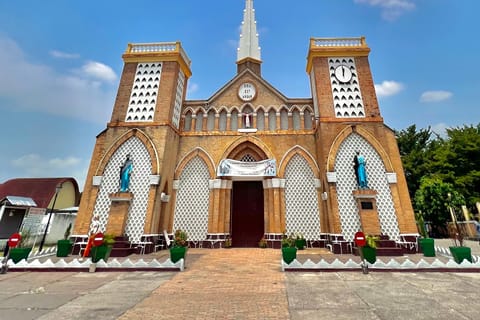
Basilique Sainte Anne du Congo
Cultural ExperiencesThe Basilique Sainte Anne du Congo rises above Poto-Poto in ochre and white concrete. It feels colonial yet entirely Congolese. Built 1943-1949 by Father Gilles, a French missionary who embedded West African curves into a Romanesque frame. High vaulted ceilings cool the interior. Stained glass throws cobalt and amber light across stone floors each morning. Painted murals depict biblical scenes with Congolese faces, fabrics, landscape. They are among the most affecting examples of inculturation art in Central Africa.
Pierre Savorgnan de Brazza Memorial
Museums & GalleriesThe Pierre Savorgnan de Brazza Memorial occupies a circular pavilion near the Congo River. It houses the remains of the Italian-French explorer who founded Brazzaville in 1880. His treaty with King Makoko gave France its foothold. The architecture is theatrical, a domed structure in polished stone that glints silver-white. Reflecting pools mirror sky and river traffic. Inside, the museum traces expeditions through photos, maps, artifacts. It also confronts Brazza's complicated legacy, more humane by Scramble standards, still an agent of empire. The city chose to memorialize this ambiguity in a building of real ambition.
Impact Centre Chrétien Congo - Église Principale
Cultural ExperiencesImpact Centre Chrétien Congo - Église Principale is not a monument but a living institution. It is the flagship church of a major Pentecostal network. Congregations fill the hall with call-and-response worship, amplified gospel choirs, and the heat of thousands of voices. The building is large and functional, not ornate. Sunday service vibrates the floor. The air smells of perfume and humid bodies. Prayer, testimony, and music cycle in a rhythm that pulls newcomers along. For travelers curious about charismatic Christianity's role in shaping Congolese society, politics, community, daily life, this church is essential.
Planning Your Visit
Practical tips for getting the most out of Brazzaville
Explore more experiences in Brazzaville
Browse live availability and pricing.
Didn't see anything interesting yet?
Browse Viator's full catalog of tours, day trips, food experiences, and private guides in Brazzaville.
See All Brazzaville Tours on ViatorReady to plan your trip to Brazzaville?
Now that you've got the research covered, here's where to go next.