Free Things to Do in Brazzaville
The best experiences that won't cost a thing
Free Attractions
Must-see spots that don't cost a penny.
La Corniche (Congo Riverfront Promenade) Free
Brazzaville's long waterfront boulevard is the city's most democratic space, no ceremony, just joggers, families, vendors, and people watching the river. From here you see that striking view across Pool Malebo to Kinshasa. The two capitals sit closer together than almost any other pair on earth. Late afternoon light on the water becomes beautiful.
Basilique Sainte-Anne du Congo Free
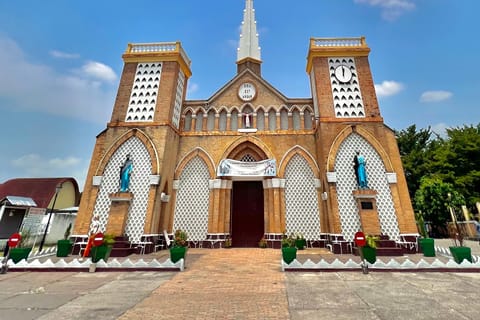
Built in 1949, this Catholic basilica dominates Bacongo with towers that flirt with Art Deco, warm ochre paint against Brazzaville sky. Free entry outside services. Inside, cool air and quiet. Total contrast to the neighborhood buzz. Bacongo rewards wandering.
Cathédrale du Sacré-Cœur Free
Brazzaville's main Catholic cathedral dates to the early colonial era. It sits in the city center, right near the administrative quarter. The architecture is less dramatic than Sainte-Anne. No contest. But the location is central and the courtyard is a pleasant place to pause. Real people come here daily. That lived-in quality? Most of Africa's touristic religious sites have lost it.
La Croix de la Lorraine (Free France Monument) Free
De Gaulle picked Brazzaville as Free France's capital in 1940, this hilltop monument marks the spot. The views alone justify the climb even if WWII history leaves you cold. Most travelers to Brazzaville walk right past this quiet overlook, missing one of the city's best vantage points entirely.
Poto-Poto Neighborhood Walking Tour Free
Poto-Poto is Brazzaville's oldest, most culturally dense neighborhood. Walking through it costs nothing, just your time. The streets pulse with energy. Workshops, tailors, food stalls, and informal commerce cram every available space. You'll find the famous Poto-Poto School of Painting here. The neighborhood's visual density reflects a long tradition of artistic production.
Marien Ngouabi Mausoleum (Exterior) Free
Marien Ngouabi's mausoleum, assassinated 1977, is Congo's sharpest piece of post-colonial architecture, planted dead-center. You can circle the whole thing from outside the fence. The monument cracks open the Republic of Congo's tangled political history without a word. Getting inside? That is another story. Guards wave most visitors off. Interior access needs permissions or luck.
Marché Total and Marché de Ouenzé Free
Marché Total is free, and it is Brazzaville's commercial nerve center. Marché de Ouenzé, up in the northern neighborhoods, won't charge you either. Both markets are absorbing if you've ever wondered how a city functions. The first sits in the city center. The second feels like a neighborhood market with better food options. You don't have to buy a thing. Just wander, watch, and appreciate the scale and organization.
Free Cultural Experiences
Immerse yourself in local culture without spending.
Poto-Poto School of Painting Free
Pierre Lods founded the École de Peinture de Poto-Poto in 1951, still the oldest, most important art school in sub-Saharan Africa. Walk in free. Watch painters work. See canvases half-finished and finished lining the walls. The style born here, elongated bodies, colors that shout, spread far beyond Africa. Today, 75 years on, some artists inside keep that same tradition alive.
Sunday Gospel Services in Bacongo and Poto-Poto Free
Sunday in Brazzaville hits different. The Christian communities, Catholic, Protestant, and the busy Kimbanguist and Pentecostal congregations, turn services into full-throated concerts that'll freeze you mid-stride. The singing in Congolese churches isn't polite background noise. It is full-voiced, communal, raw power that spills through open doors and windows. Most churches welcome respectful visitors. Just show up.
Congolese Rumba and Live Music at Local Bars (Free Entry) Free
UNESCO just stamped Congolese rumba as Intangible Heritage, and the Republic of Congo is where the beat started. That sound shaped most Central African pop. On weekend evenings, bars and open-air terrasses in Poto-Poto, Bacongo, and Moungali throw live sets with no cover, just buy a drink. You'll hear the real thing, not some packaged cultural show.
Jardin Botanique de Brazzaville Free
Brazzaville's botanical garden dates to the French colonial era, one of Central Africa's older institutions. The tropical trees and plants have had decades to mature into an impressively canopied canopy. Maintenance isn't European-style immaculate. That roughness works. It gives the place a wild edge that fits the equatorial heat. Entry is free or nominally priced depending on when you visit.
Free Outdoor Activities
Get outside and explore without spending a dime.
Pool Malebo Riverbank Beaches Free
North and south of Brazzaville, sandy banks of the Congo River turn into weekend living rooms. Locals swim, scrub clothes, trade gossip, on weekends and late afternoons. Kintélé, upriver, offers the city's nearest patch of leisure "beach." The view across Pool Malebo, one of the widest river sections on earth, hits harder than any postcard.
Walking the Plateau Neighborhood Free
Brazzaville's Plateau district, the elevated administrative quarter, is where the colonial-era city was laid out, and it keeps that old spatial generosity: wider streets, older trees, buildings set back from the road. Pleasant walking here in early morning before heat builds. You'll pass main government buildings, embassies, some handsome if aging architecture. Quieter than Poto-Poto or Bacongo. That quiet is itself worth something.
Evening Walks Along La Corniche Free
5pm flips the switch. The riverfront promenade erupts, vendors appear, families flood in, and the Congo River's cooler air turns a simple walk into something you'll stretch far past dinner. Free. No tickets. Just the slow reveal of Kinshasa's lights across the water, two capital cities mirrored in the same dark current, so quietly notable you'll forget to check your watch.
Budget-Friendly Extras
Not free, but absolutely worth the small cost.
Grilled Fish and Brochettes at Riverside Stalls $1, 3 (500, 2,000 FCFA)
Grilled fish is lunch. Along the Congo River and in the major neighborhoods, tilapia, capitaine, and catfish hit the coals. They're served with fried plantain, rice, or fufu. A full plate at a riverside stall, or a sit-down at one of the simple open-air restaurants in Poto-Poto, runs somewhere between 500 and 2,000 FCFA depending on what you order. This is what most Brazzavillois eat for lunch.
Musée National de Brazzaville $1, 2 (approximately 500, 1,000 FCFA)
The masks will stop you first, Brazzaville's national museum packs Congolese history, traditional crafts, musical instruments, and colonial-era artifacts into a tight hall. Scale? Forget it. Presentation? Basic. Yet the line of carved faces, hand-loomed textiles, and village objects from every corner of Congo tells you more about the country than any capital briefing. Entry fees are modest.
Pirogue (Dugout Canoe) Ride on the Congo River $2, 5 (negotiated with the boatman, typically 1,000, 3,000 FCFA)
Forget the Kinshasa ferry, Brazzaville's pirogue men will shove you onto the Congo for 20-30 minutes of city-view chaos. You won't leave the country; you'll simply slide along the Brazzaville bank and feel the river's muscle. Prices? Negotiable, always modest. From the water the city's skyline shrinks and the river's scale turns arrogant, an angle no bridge can give.
Local Brewery Tour or Bar Visit (Brasserie du Congo / Primus) $0.50, 1.50 per beer (300, 800 FCFA depending on the venue)
Primus and Ngok are the beers you'll find everywhere in Brazzaville. They're produced locally and priced accordingly. Grab a cold Primus at an open-air terrasse bar in Poto-Poto or along the Corniche late afternoon. It costs almost nothing by any standard. You get an hour of watching the city at its most relaxed. Some local bars will do informal tours of their brewing operations if you ask nicely.
Traditional Congolese Restaurant Lunch (Poulet Moambé and Saka-Saka) $2, 5 (1,000, 3,000 FCFA for a full meal with rice or plantain)
Poulet moambé, chicken braised in palm nut sauce, is Brazzaville's calling card. A proper plate at a local restaurant (skip the hotel dining room) costs little and lingers in memory. Saka-saka, cassava leaves cooked with fish or smoked meat, is the other must-eat. Locals devour these dishes daily. Visitors can't stop talking about them.
Tips for Free Activities
Make the most of your budget-friendly adventures.
Our guide covers the best areas to stay in Brazzaville for every budget.
Where to Stay →Popular Paid Experiences in Brazzaville
Looking for something extra? These are the top-rated bookable activities.
Explore More Activities in Brazzaville
Didn't see anything interesting yet?
Browse Viator's full catalog of tours, day trips, food experiences, and private guides in Brazzaville.
See All Brazzaville Tours on ViatorReady to plan your trip to Brazzaville?
Now that you've got the research covered, here's where to go next.