Things to Do in Brazzaville in July
July weather, activities, events & insider tips
Low Season · Budget Friendly
July Weather in Brazzaville
Long-run averages for July
82°F (28°C)
High Temp
67°F (19°C)
Low Temp
0.1 inches (3 mm)
Rainfall
70%
Humidity
7
Sunny-Day UV
⚠ Dry-season dust and haze reduce air quality, in market quarters and along unpaved roads in outer neighbourhoods. Travelers with respiratory sensitivities should carry a dust mask or buff. Limit prolonged walking in Poto-Poto during peak afternoon heat when dust suspension is highest.
⚠ Malaria transmission continues year-round in Brazzaville, including during the dry season. Mosquito activity drops compared to wetter months but does not cease, near the river and in low-lying areas after sunset. Antimalarial prophylaxis and evening insect repellent are essential. They are not optional.
Is July Right for You?
Weigh the advantages and considerations before booking
Advantages
- + July is the driest month Brazzaville sees all year, with a mere 0.1 inches (3 mm) of rainfall. The skies over the Congo River stay clear for days at a stretch. The red laterite roads through Poto-Poto and Bacongo firm up enough that walking the city on foot is pleasant rather than a mud negotiation. You can plan outdoor days without watching the horizon for thunderheads.
- + Humidity drops to around 70%, which by Central African standards feels almost crisp. Compared to November's suffocating 83% and 10.4 inches (264 mm) of rain, July mornings along the Corniche waterfront carry a coolness that surprises first-time visitors. This is dry-season air where you can walk for an hour without your shirt sticking to your back. Evenings dip to 67°F (19°C), cool enough for a light layer.
- + Tourist traffic in Brazzaville is thin in any month. But July sees even fewer visitors than the already-modest baseline. The Mausolée de Brazza, the Basilique Sainte-Anne, the national zoo. You will likely have these places nearly to yourself. No queue lines. No reservation battles. No jostling for photographs. The city moves at its own pace and you slot right into it.
- + The dry season aligns with Brazzaville's most active cultural calendar of outdoor gatherings. Weekend afternoons in Bacongo and along the Corniche bring out the sapeurs. These are the city's legendary dandies, dressed in three-piece suits and polished shoes that cost more than most people's monthly rent. Their promenades function as open-air theatre. July's dry, mild weather makes these gatherings more frequent and more elaborate than the rain-soaked months when everyone stays indoors.
Considerations
- − July's dry air carries a fine reddish dust that settles on everything. Your camera lens, your clothes, the inside of your bag. The harmattan-adjacent haze thins the light and softens the horizon over the Congo River, which is atmospheric. But visibility for long-distance views toward Kinshasa across the water is noticeably reduced compared to the washed-clean clarity after a wet-season downpour.
- − Brazzaville's tourism infrastructure remains limited regardless of season. Options for guided experiences, organized day trips, and English-speaking services are sparse compared to East or Southern African capitals. You will need functional French or Lingala for most interactions outside the handful of internationally oriented establishments. July's dryness is an advantage. It does not change the city's fundamental character as a destination that rewards self-sufficient travelers.
- − The dry season coincides with reduced vegetation. The green canopy that makes Brazzaville one of Central Africa's leafiest capitals looks noticeably thinner and dustier in July. The botanical gardens and the road out toward Les Rapides du Djoué lose some of their lushness. If your mental image of Congo is dense, dripping-green tropical forest, July will gently correct that assumption.
Best Activities in July
Top things to do during your visit
Congo River Waterfront Walks and Pirogue Excursions
July is the month to be on the Congo River. The water level has dropped from the wet-season highs, exposing sandy banks along the Corniche that disappear under brown flood for half the year. The current slows enough that pirogue operators run trips upriver toward Ile Mbamou. This is a long, flat island where fishermen smoke their catch over green-wood fires. The smell of charred capitaine drifts across the water. With humidity at 70% and highs around 82°F (28°C), you can spend a full morning on the river without the oppressive heat that makes the same trip in March feel like sitting inside a steam room. The light on the water in the late afternoon, filtered through the dry-season haze, turns everything amber. Mornings are best. The river surface is glassy before 9 AM, and you will see fishing nets being hauled in along the banks.
Booking Tip: Arrange pirogue trips through licensed operators at least a few days ahead, as the reliable captains with proper life vests book up on weekends. Aim for early morning departures. See current tour options in the booking section below for organized river excursions.
Poto-Poto Art Quarter and Market Immersion
The Poto-Poto quarter is where Brazzaville's artistic identity lives. This is a dense grid of workshops, open-air studios, and market stalls that has produced painters and sculptors since the 1950s when the Ecole de Peinture de Poto-Poto put Congolese contemporary art on the international map. July's dry conditions mean the market spills further into the streets than during the wet months, when vendors retreat under corrugated roofing and the lanes flood ankle-deep. You will smell palm oil heating in enormous blackened pots, hear Congolese rumba leaking from transistor radios balanced on stacks of manioc, and feel the particular grit of red dust under your sandals. The painters work outside in July. You can watch a canvas take shape over an afternoon. The market is overwhelming in the best way: towers of smoked fish, stacks of printed wax-cloth fabric in geometric patterns, and somewhere in the middle, someone grilling makemba plantains over charcoal that sends sweet smoke drifting between the stalls.
Booking Tip: Go early, before 10 AM, when artists are setting up and the light is still cool enough for walking. A local guide who knows the quarter makes the difference between wandering past closed shutters and sitting in a sculptor's workshop watching ebony take shape. Check the booking section below for walking tour options.
Basilique Sainte-Anne and Bacongo Heritage Walking
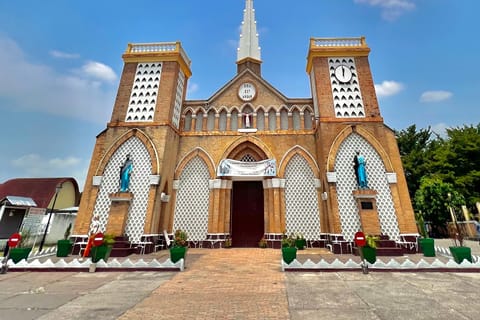
The Basilique Sainte-Anne du Congo is one of the most striking pieces of architecture in Central Africa, a soaring green-tiled roof that rises above the Bacongo neighbourhood like something between a Gothic cathedral and a giant origami fold. July's clear skies mean you see the full drama of it against sharp blue, without the low grey cloud cover that flattens everything during the wet months. Inside, the stained glass throws coloured light across the concrete floor in geometric patterns that shift through the morning. But the real draw of a Bacongo walk is the neighbourhood itself. This is sapeur heartland, where the dandyism tradition runs deepest. On a July Sunday afternoon, you might turn a corner and find a man in a pink three-piece suit with matching pocket square and Italian shoes, posing against a crumbling concrete wall with absolute seriousness. The contrast between the worn infrastructure and the immaculate self-presentation is Brazzaville distilled into a single image.
Booking Tip: Sunday mornings combine the basilica's services with the sapeur promenades that follow. No advance booking needed for the church itself. Guided heritage walks through Bacongo should be arranged a few days ahead through local cultural operators. See the booking widget below for current options.
Les Rapides du Djoué Nature Excursion
About 15 km (9.3 miles) south of central Brazzaville, where the Djoué River crashes over a series of rock shelves before joining the Congo, you hit the closest thing the city has to wilderness. July's low water levels expose the rock formations more dramatically than any other month. You can pick your way across boulders that spend November through April completely submerged. The spray from the rapids throws mist that catches the sunlight, and the surrounding forest, while drier than its wet-season peak, still echoes with bird calls in the morning. The temperature at the rapids tends to run a few degrees cooler than the city center thanks to the water and canopy shade, making midday visits comfortable when central Brazzaville is hitting its 82°F (28°C) peak. Bring proper shoes. The rocks are slick with algae near the water line.
Booking Tip: Half-day trips are the right duration. Arrange transport through a guide or organized excursion rather than navigating independently, as the final stretch of road can be rough. Book a couple of days ahead. Confirm the operator provides water and knows the safe access points. Check available excursions in the booking section below.
Congolese Cuisine and Street Food Exploration
July is arguably the best month to eat your way through Brazzaville on foot, because the dry weather keeps the street food economy running at full tilt. Start at the grilled-fish vendors near the river port in the morning. Whole capitaine (Nile perch) butterflied and pressed onto charcoal grills, the skin crisping while the flesh stays white and flaky, served on a scrap of brown paper with a mound of chikwangue (fermented cassava paste wrapped in banana leaves that has a sour, chewy density unlike any bread you have eaten). The saka-saka stalls in Poto-Poto cook cassava leaves for hours until they break down into a dark green, almost creamy stew enriched with palm oil and smoked fish. The smell of palm oil and wood smoke is the signature scent of Brazzaville's cooking. For something sweeter, the roasted makemba plantains sold at intersections throughout Bacongo caramelize on the outside while staying soft and starchy within. Evening brings out the brochette sellers, threading goat meat onto metal skewers over charcoal that glows orange in the dark, the fat dripping and hissing.
Booking Tip: Food walks are best with a local guide who knows which vendors have been operating longest and which spots to avoid. Evenings are prime time for brochettes and grilled fish. Look for guided food experiences in the booking section below. Or simply follow the smoke and the crowds.
Where to Stay in Brazzaville in July
Hand-picked hotels across price tiers for July travellers.
Packing Checklist
Bookmark this page — your progress is saved between visits
Need the full list with shopping links?
Climate-specific gear, brand recommendations, and what to leave at home.
View Brazzaville Packing List →Essential Tips
Insider knowledge and common pitfalls to avoid
Insider Knowledge
The sapeur promenades in Bacongo peak on Sunday afternoons. The real spectacle happens at funerals and weddings. That sounds counterintuitive. Congolese celebrations of life involve the most elaborate displays of dress. If you hear rumba music and see a crowd around a well-dressed man doing a slow, deliberate walk, you are witnessing la sape in its truest context. Locals are proud to explain. They often invite onlookers to watch.
Brazzaville and Kinshasa sit barely 5 km (3.1 miles) apart across the Congo River. This makes them the closest pair of national capitals on Earth. The ferry crossing is available but involves serious bureaucracy. You need a DRC visa arranged in advance. The process at the port can consume hours. July's calmer water makes the crossing smoother than wet-season months when the current runs fast and the boats pitch uncomfortably. Sort visas before leaving home. Budget a full day for the logistics.
French is the official language. You will need it for any transaction. Lingala is the street language. Learning even a few phrases changes how people interact with you. Try mbote for hello. Use matondi for thank you. Market vendors in particular warm up noticeably when you try Lingala rather than defaulting to English, which relatively few Brazzavillois speak.
The Mausolée de Brazza is the marble memorial to the city's colonial-era founder Pierre Savorgnan de Brazza. It is architecturally impressive. It is also politically complicated. Built in the 2000s at enormous expense, it sits largely empty most days. Locals have mixed feelings about celebrating a colonial explorer. That tension is part of what makes visiting it interesting rather than just another monument check on a list. Go in the morning. The marble interior stays cool. The guard on duty is more likely to share the building's contested history.
Avoid These Mistakes
Do not assume Brazzaville and Kinshasa are interchangeable or easily combined. They are in two different countries with separate visa requirements, different currencies (CFA franc vs Congolese franc), and vastly different atmospheres. Crossing the river without pre-arranged DRC documentation means you are not crossing at all. Plan each city as its own trip.
Do not pack only tropical-weight clothing. You will get cold after dark. July evenings at 67°F (19°C) with a breeze off the Congo River feel chilly after a day in 82°F (28°C) sun. The temperature swing catches nearly every first-timer. Pack a fleece layer. This saves you from buying an overpriced jacket at the airport.
Never drink tap water. Avoid unwashed raw produce from market stalls. Waterborne illness is the fastest way to lose days of your trip. Stick to filtered or bottled water. Eat cooked food from stalls where you can see the heat. Peel your own fruit. This is not overcaution. It is the baseline that every resident follows.
Ready to plan your trip to Brazzaville?
Now that you've got the research covered, here's where to go next.
Book Experiences in Brazzaville
Top-rated things to do in Brazzaville this July
Explore More Activities in Brazzaville
Didn't see anything interesting yet?
Browse Viator's full catalog of tours, day trips, food experiences, and private guides in Brazzaville.
See All Brazzaville Tours on Viator